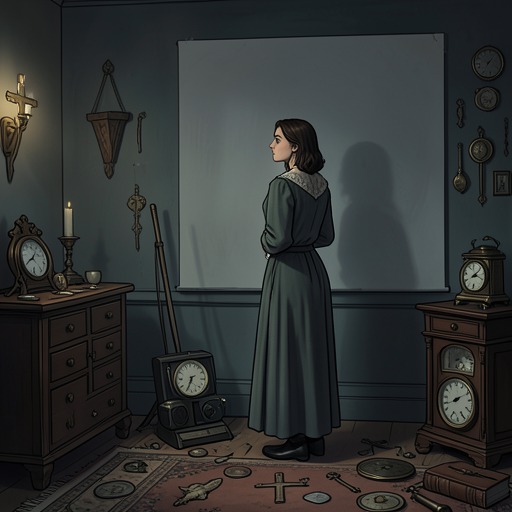
Six Days of Creation
The Blazing WorldThe Six Days of Creation enters the book as a question of biblical interpretation in the Empress’s examination of the Immaterial Spirits. Asked whether the universe was made within six days or whether the days signify a number of God’s decrees, the Spirits answer that the world was made by God’s all-powerful decree, but that no creature can say whether there were six commands, fewer, or more. The exchange affirms divine creation while withholding any creature’s certainty about its temporal or numerical form.
The Question and the Answer
The Empress sets out two readings: six days as the duration of creation, or six days as a figure for divine commands. The Spirits do not choose between them. Instead, they distinguish the certainty that God’s decree made the world from the unknowability of how many decrees there were. Their answer leaves the scriptural number unresolved rather than turning it into a definite chronology.
This restraint fits the Spirits’ broader limits on knowledge. They say that no created being possesses God’s absolute and perfect knowledge, and that no creature can fully know God. On the creation question, therefore, their refusal to settle the number is not a competing account of the world’s origin; it marks the boundary between a theological claim about divine power and details inaccessible to creatures.
Creation and Self-Moving Nature
The dialogue also places creation alongside a natural philosophy in which matter is not inert. The Empress argues that Nature is one infinite, self-moving body, divided into innumerable parts that continually change through composition and division. On this account, self-moving matter is the universal principle responsible for natural effects; fire, water, and other proposed elements are particular effects of Nature, not the ultimate ingredients from which it is made.
The Spirits’ discussion of matter and motion reinforces the importance of that material account without explaining the mechanics of creation. They say that matter was always as it is, comprising rare and dense, fluid and solid parts, and that God was not bound to make all matter fluid at first. They also insist that motion exists only in matter: without matter’s motion, the Spirits themselves could neither move nor answer the Empress. The creation exchange thus leaves the divine act beyond creaturely explanation while the surrounding discussion treats a moving material world as the condition of natural life and action.
The Limits of Number and Explanation
The conversation turns directly from the number of creation’s days to the supposed mysteries of numbers. The Spirits reduce numbers to marks of remembrance used for counting, rejecting the idea that numbers possess hidden natural or divine meanings. The Empress raises the claims that four contains all numbers, that six symbolizes marriage, and that seven emblematizes God; the Spirits deny that any number can serve as an emblem of God, whom creatures do not know, and describe numbers as imperfect beside divine perfection.
This sequence makes the six days a pointed test of interpretation. A number may organize a human account of creation, but the Spirits do not allow that organization to prove how the divine act unfolded. The dialogue separates the world’s origin by God’s command from human attempts to extract a complete chronology or secret doctrine from numerical patterns.